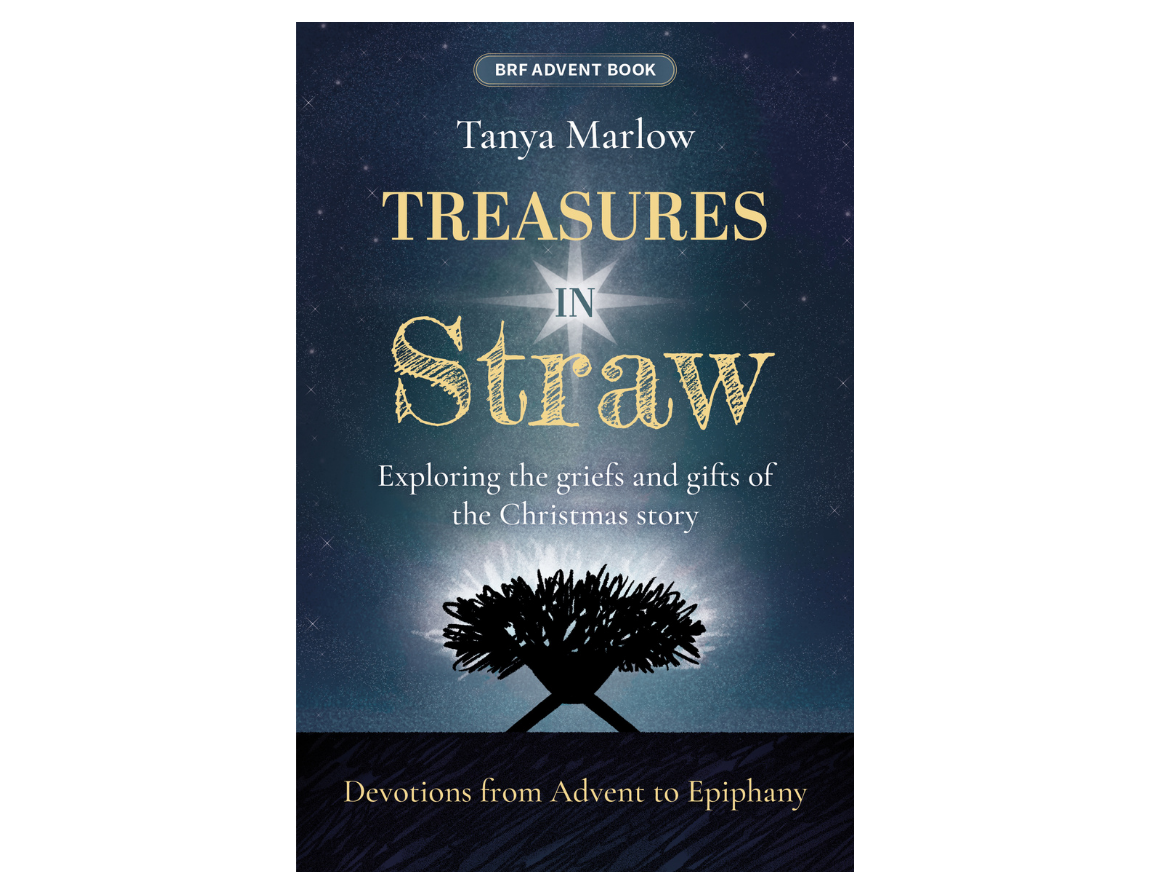
Introducing our 2026 Advent book, Treasures in Straw: Exploring the griefs and gifts of the Christmas story, by Tanya Marlow. Writing about her inspiration for Treasures in Straw, Tanya said:
‘I wanted to write a devotional beyond the usual tinselled tellings of wonder at Christmastime, and get to the grittier faith beyond our children’s nativities. We know the story so well we assume the happy ending, but actually there was a lot of danger, sacrifice and loss wrapped up in the various characters in the Christmas story. For me, digging into those darker aspects made the blessings shine more brightly. There is a costliness to the Christmas story, and I think that is relatable.’
We hope you enjoy this extract from the introduction to the book, and that it might inspire you to make Treasures in Straw your Advent companion for 2026.
1 November 2026
Gifts and griefs
How do you feel about Christmas? Generally, I love it. For me, Christmas means comforting traditions, little treats, and inspirations throughout Advent, and the delight of watching my son opening his presents – spiritual, emotional, and physical nourishment.
For my friend Helen Austin, it is quite different. Issues with grief, mental illness, and chronic physical illness (including having a restricted diet) have made it harder to enjoy the day itself. Being single at Christmas-tide, when everyone is talking about their fun family gatherings, plus being childless (not by choice) at a festival focused on childbirth, cruelly accentuates the losses Helen feels in everyday life. In December 2025, Helen confessed on Facebook that for several years she ‘avoided all things Christmas, including church, for the whole month of December, because it was just all so painful’. She is not alone in this.

Unfortunately, joy is not the only feeling Christmas can intensify.
Emotions and the Christmas phenomenon
Christmas is a megaphone. In the west, particularly the UK, we have established Christmas as the magical bringer of joy, cosiness, and warmth in winter, quality time with a loving family, perfect presents, good food, and, perhaps above all, children filled with wonder.
Neuroscience tells us that if we grew up enjoying Christmas, then every ritual and tradition associated with Christmas will reinforce our ‘classic conditioning’ to automatically feel positive with each reminder. Like Pavlov’s dog salivating every time a bell rings, we experience that Christmassy glow every time we put up decorations, sing carols, or, ironically enough, hear bells ringing. If we are happy in life, Christmas-tide has the power to amplify that feeling.
Unfortunately, joy is not the only feeling Christmas can intensify. Because there is so much expectation of Christmassy perfection built upon this one day of the year, if our circumstances prevent us from having a happy Christmas, the grief is so much stronger on this day. Nothing bad is supposed to happen on birthdays, holidays, or Christmas Day, so if it does the sense of betrayal is even more pronounced. Every Christmassy ritual then becomes a mocking reminder of all that is lost.
Kenneth Doka called this experience ‘disenfranchised grief’: grief not validated by society. It is frowned upon to express sadness or look for support from others at a time of communal feasting.
Disenfranchised grief can also include feeling sad. Arlie Hochschild observed that emotions are not just personal and isolated, but heavily influenced by cultural expectations, which she calls ‘feeling rules’. That pressure is so strong that if we aren’t experiencing the expected communal reaction naturally, we do what Hochschild calls ‘emotion work’. This involves not only concealing our feelings in front of others, so we don’t display the ‘wrong’ emotion in our faces, but also trying to control the emotion itself.
Then, if we are Christians, we add the extra expectation of being obliged to rejoice at Christmas because Jesus was born. The cultural obligation of feeling happy now extends to sacred spaces and religious communities, where we really ought to be happy – because ‘Jesus’. Our emotions become a measure of our devotion.
Yet even if we do feel happy, our motivation must be scrutinised. I remember feeling guilty as a child because I knew I should feel most happy about Jesus being born for us, but I was honestly more excited about getting roller skates.
It is exhausting, and it is no wonder that so many people avoid Christmas altogether. The jarring juxtaposition of the world’s merriment and our pain is just too much to bear.

As I looked again through the original Christmas story, I saw that loss and sacrifice were everywhere.
Christmas versus nativity
The reason I wrote this book was because I saw such a difference between Christmas as we mark it today versus the original story of the nativity. Then, there was joy, yes, and gifts, but there was also sorrow and sacrifice. Mary had a baby, the Saviour of the whole world, but not everyone was happy about it, most notably Herod. The images on Christmas cards are of holy mother, father, baby, all perfect and respectable, but the nativity had a non-typical family structure, with Joseph as stepfather and Mary probably suspected of sexual impropriety.
Christmas today is obsessed with children’s happiness, though this wasn’t always the case. For centuries in Britain, Christmas was a lengthy, communal, mainly adult festival for several days, intended for resting after the harvesting (with rowdy and alcoholic revelry). The Victorians, desiring societal control, shifted Christmas to one day only: nuclear families with their well-behaved, innocent children, quietly, privately, celebrating around their fir trees at home. Then it was back to the factory the next day. Materialism and greed then spawned the modern, jolly, gift-giving, cola-bringing Santa in the 20th century.
Yet the good news of Christ was not aimed at individuals or even families but marginalised communities and forgotten peoples. The ‘perfect’ Christmas today is easier to achieve if you’re rich; yet Christ was born into poverty, and Mary sang triumphantly about the rich being sent away.
As I looked again through the original Christmas story, I saw that loss and sacrifice were everywhere. Against that dark backdrop, the gift of God-with-us shone more brightly. The losses within the nativity were temporal, relational, or material, but the gains were spiritual and eternal. It was less about cosy stables and more about upending unjust societies. It was less about individual gifts and more about communal equality.
The costs were often great, but the reward of Jesus was greater. The griefs were deep, but the joys lasted longer. They had a taste of God’s kingdom in Christ’s first coming, and the promise of fulfilment in Christ’s second coming.
They and then is also us and now. Life is good and glorious but also hard and painful. We celebrate and rejoice that Jesus came, and we also long for Jesus’ coming. We love our world but also grieve for it and crave its restoration. We are thankful for our personal blessings and torn apart by our personal sufferings.
Christmas devotionals are notorious for being abandoned halfway through as the season gets busier, so do give yourself permission to start early or catch up and speed-read when you’ve missed a few days. Or wait for a quieter moment and read it in weekly sections rather than day by day. The book has a flow, arc, and transformational purpose, and the full journey is worth undertaking, I promise.

The nativity was not saccharine, tinselled jollity, isolated from the world’s problems.
Both grief and gift together
Nowadays Christmas feels like either grief or gift; the nativity is both grief and gift together.
God has entered our world and experienced it fully, the good and the bad. At his second coming, Jesus will entirely restore the world. One day, it will be all gift; until then, we live with both.
Christmas can sometimes feel superficial or smug, but the nativity was not saccharine, tinselled jollity, isolated from the world’s problems. The nativity was mess and order, peace and disruption, joy and sorrow, darkness and light, disgrace and honour, danger and protection, poverty and provision, uncertainty and hope, temptation and tyranny, grief and celebration. All of life is there, raw and true. And all are invited in.
My invitation to you this season is to look afresh at the original Christmas story, with the freedom to be honest in lament, exuberant in praise, or both together. Whether you love Christmas or dread it, this is a chance to treasure those forgotten spiritual blessings that do not perish or fade, and rediscover genuine delight in Jesus, our greatest gift.