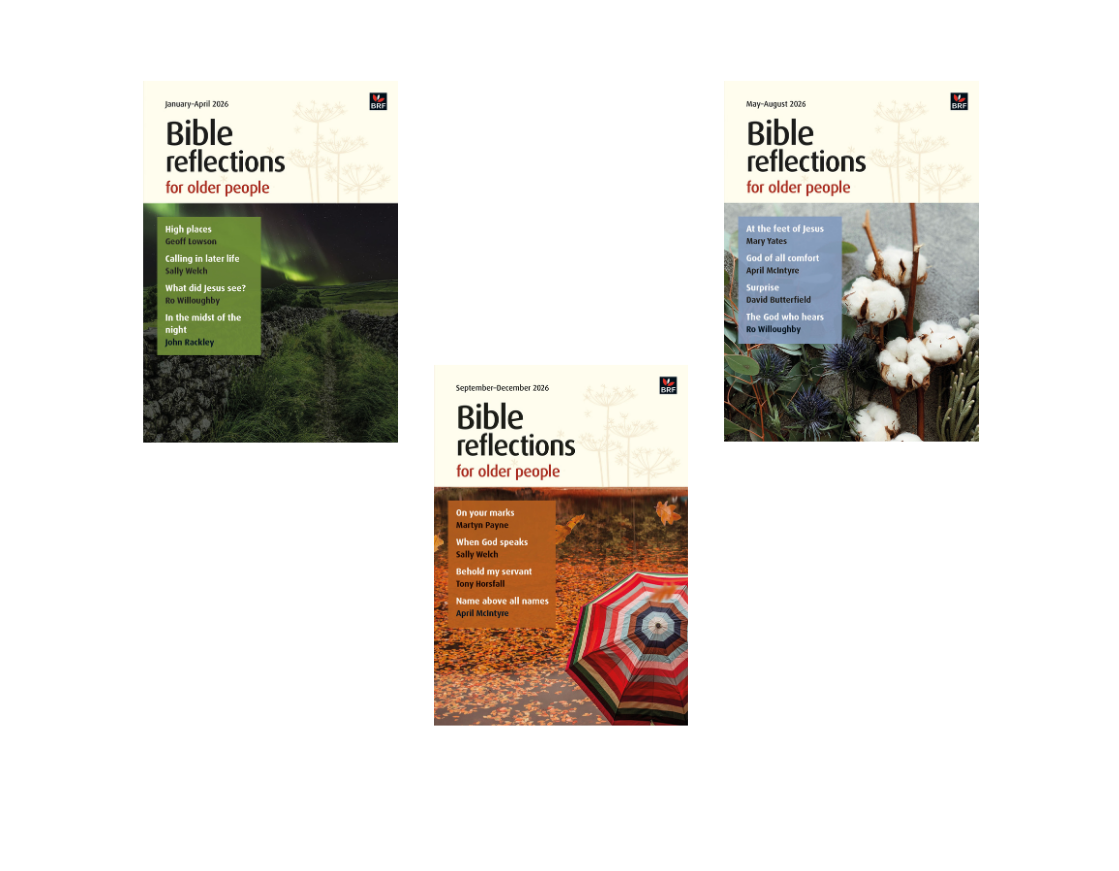

We conclude our summer series highlighting the riches of our new September–December Bible reading notes. This week we focus on Bible Reflections for Older People, our series written by older people, for older people, to bring hope, assurance, sustenance, and gentle challenge.
23 August 2026
Well-loved writer Martyn Payne’s series is about discipleship. His words ring true whatever our age, and whatever stage we’re at in our journey of faith.
On your marks
Therefore, since we are surrounded by so great a cloud of witnesses, let us also lay aside every weight and the sin that clings so closely, and let us run with perseverance the race that is set before us.
Hebrews 12:1 (NRSV)
I wonder what experiences or memories you have of taking part in a running race? Maybe it was the egg and spoon at primary school, or competing in the county trials as a teenager, or perhaps you still occasionally go for a jog with a friend.
This scripture above is all about Christian discipleship, which the writer likens to a race, where all encumbrances are set aside, as we look to Jesus who is the beginning and the end of our faith. The imagery is drawn from athletics. There are crowds in the stands cheering us on. These are those who have gone before, running the same race, and who are now in heaven. They include all those who at some time or another have encouraged us on our Christian journey. We are not alone in this race.
And as for any athlete in the arena, to run well, we need to discard unnecessary weights. These weights come in all shapes and sizes and, over the coming reflections, we will look at some of these, seeking to lay them aside to help us focus on the race and particularly on the front runner, who is Jesus.

There are crowds cheering us on, those who have gone before and who are now in heaven.
Forgetting
One thing I do: forgetting what lies behind… I press on toward the goal, toward the prize of the heavenly call of God in Christ Jesus.
Philippians 3:13b–14 (NRSV)
Here is one more weight to shed in the Christian race, as we look to Jesus.
‘Forgetting’ is recommended by Paul, and it comes out of his own experience of leaving behind the way of striving to become the best Jew possible in order to please God. There are, of course, positive experiences that happen in our lives which we should not forget, but Paul isn’t talking about those things.
Paul is thinking about the negative and unhelpful things that distract us from moving forward with Jesus. For example, dwelling on past hurts; or replaying the bad things that have happened to us as we remember painful situations where we were badly bruised. Not forgetting the harsh words people have said about us can disable us in the race.
It’s these things that we need to leave behind and strive to forget, as we become caught up instead with ‘now’, and with what God is doing and will be doing in our lives. There is a past to remember for good, but there is also a past that needs to be forgotten, also for our good.

There is a past to remember for good, but there is also a past that needs to be forgotten, also for our good.
No unforgiveness
‘Whenever you stand praying, forgive, if you have anything against anyone; so that your Father in heaven may also forgive you your trespasses.’
Mark 11:25 (NRSV)
Mark does not include a version of the Lord’s Prayer in his gospel, but there is an echo of it here in these verses, in the conversation Jesus has with Peter. It’s all about forgiveness.
Forgiving others is the most important thing that human beings can do for one another. Where there is unforgiveness, we carry a dead weight that can seriously disrupt our discipleship race.
We all long for forgiveness. We want the hurts we have sustained to be healed and broken relationships to be mended. However, if we can’t forgive others, then we make it impossible to receive the forgiveness that God longs to give us.
It’s almost as if the secret both of believing prayer and being a true disciple is being willing to forgive. To forgive others makes possible our own experience of forgiveness, as we let go of a weight that will otherwise stop us running.

Forgiving others is the most important thing that human beings can do for one another.
No self-sufficiency
‘My grace is sufficient for you, for power is made perfect in weakness.’
2 Corinthians 12:9a (NRSV)
We live in a world that exults in self-sufficiency. If you’re able to look after yourself and make it on your own, then you are successful in the world’s eyes. This, however, is not the way of Jesus and this is not how to run the race.
We were created to depend on God. This is what Paul discovered when he experienced the calamities of life, documented so fully in his second letter to the Christians in Corinth. He learned he couldn’t make it on his own; he knew that life is too difficult. In his weakness he needed God’s power.
And this is how we are to run the race of faith, not relying on our own strength, which will only weigh us down, but in the presence of God working within us, whenever we stumble. As we look to God, we discover God’s grace coming to us, particularly through the support of those who care for us. Similarly, we too can help others run the race. The discipleship race isn’t all about me, but about us, racing together, ‘looking unto Jesus’ and depending on God.