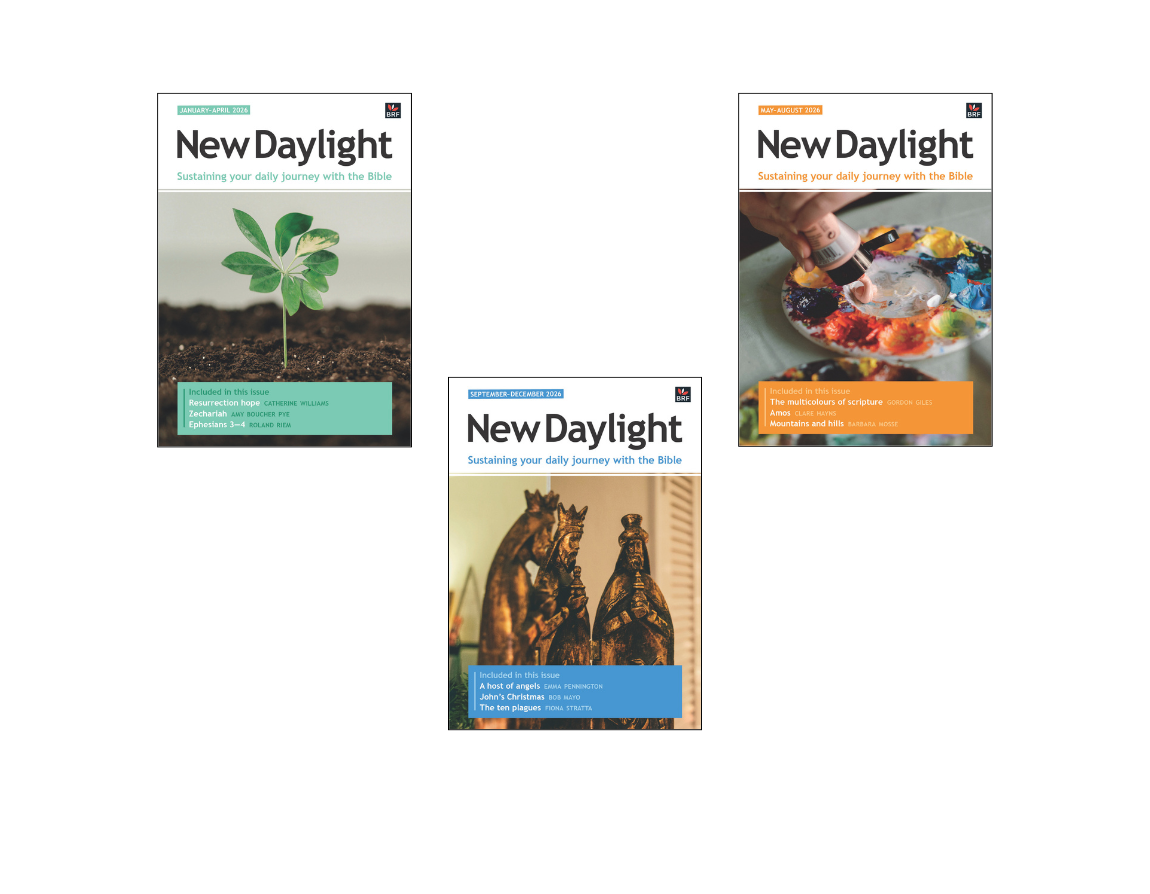

The September-December issues of all our Bible reading notes are now available and over the next few weeks we’ll be highlighting some of the riches to come. We begin with our most popular notes, New Daylight, and a series coming up in October by the editor, Gordon Giles. As thousands of people head to the coast at the start of the school holidays, Gordon has a characteristically original take on his theme ‘The sea, the sea’, in the series which runs 4–17 October.
26 July 2026
The sea, the sea
Welcome aboard! Join me on a cruise through the Bible, from Genesis to Revelation, as we set sail over the waters of creation and flooded mountains, crossing the Red Sea (or Sea of Reeds) and the Mediterranean, and from thence to meet Jesus on the freshwater Sea of Galilee. Then we shall sail with Paul around Asia Minor, until his ship is wrecked. As we sit on the beach admiring the waves, James has some metaphorical advice for us, and then John reveals some final wisdom about the spread of the gospel over land and sea before consoling us with the hope that in the new heaven and earth there is no more sea.
We shall navigate the high and low seas, praying not to be eaten by sea monsters or swallowed by great fish, thrown overboard or shipwrecked. We shall see heaven and earth, the lofty skies and the fathomless deeps.
All this happens on, and relates to, our tiny blue planet, which when viewed from the heavens looks like a mass of water with some land: 71% of the earth’s surface is ocean, and between 50% and 80% of all life on earth lives in it. By volume, 99% of the planet’s living space is submarine, and we have only explored 20% of it. Only 26% of the sea floor has been mapped.
If ever we need reminding that creation is so much bigger and more mysterious than we have come to assume it is, we need only contemplate how little of two-thirds of our planet we actually know about.
Such knowledge – or rather lack of it – is too great for us, and it is humbling to a world that talks of the sea of faith as something which the human mind has conquered and dismissed. Out there are vast oceans of truth, revealing the glory of God and reminding us that, in Jesus, God not only creates the heights and the depths but also loves and commands them and all who dwell in, around, and on them.
We live on water, we depend on water, we are made of water. The seas make it happen – no wonder God created them after light as the kickstarter for life. So let us cast off and sail into biblically charted but perhaps unexplored waters.
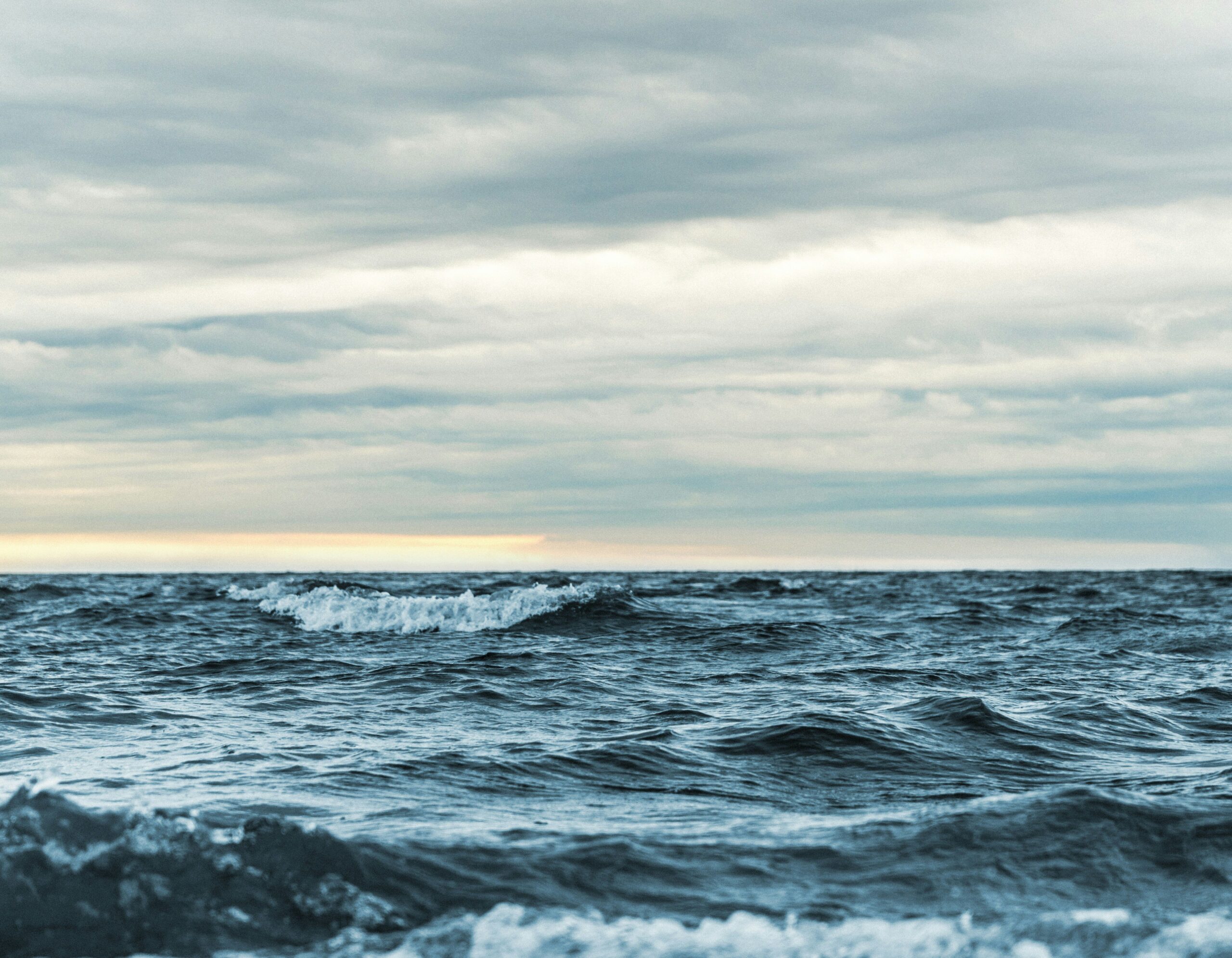
Creation is so much bigger and more mysterious than we have come to assume it is.
Sea monsters
Praise him, you highest heavens, and you waters above the heavens! Let them praise the name of the Lord, for he commanded and they were created. He established them forever and ever; he fixed their bounds, which cannot be passed. Praise the Lord from the earth, you sea monsters and all deeps.
Psalm 148:4–7
Sea monsters are found in Jewish, Norse, and Greek legends. The Kraken is likely an interpretation of a Norwegian cephalopod, perhaps a giant squid, which can grow to 34 feet (10.5 metres) long. In Greek mythology, Scylla and Charybdis are sea monsters who inconvenience Odysseus, Jason, and Aeneas. Furthermore, in Greek a Kêtos is a large sea monster; Perseus killed one to save Andromeda, as did Heracles to rescue Hesione. The Latin cetacean still refers to around 94 species of whale.
Judaism has its Leviathan. Found in Psalms 74:14 and 104:26, Job 41:1, and Isaiah 27:1, sometimes it is a metaphor for Babylon or an embodiment of chaos. Eventually, it is annihilated. In Christian tradition Leviathan is associated with the sin of envy. Even in the UK, we have our own mysterious legend of the Loch Ness Monster.
Clearly all seafaring cultures respect the sea, but fear the giant creatures that lurk within. They associate the anger of the gods with the terrible traumas that sea creatures can inflict. Whether deliberately or by accident, whales can cause the destruction of a ship with a flick of the tail.
Therefore, it is no surprise that in praising the creator of the seas and skies, the psalmist recognises sea monsters as part of creation. We find a similar approach to dragons in the apocryphal Wisdom of Solomon, those who ‘breathe out fiery breath, or belch forth a thick pall of smoke, or flash terrible sparks from their eyes… But you have arranged all things by measure and number and weight’ (11:18, 20).
No one doubted the existence of these deadly creatures, they are recognised as created by God, who, capable of inflicting destruction, are agents of the creator. Thus they, and we, should praise the Lord.
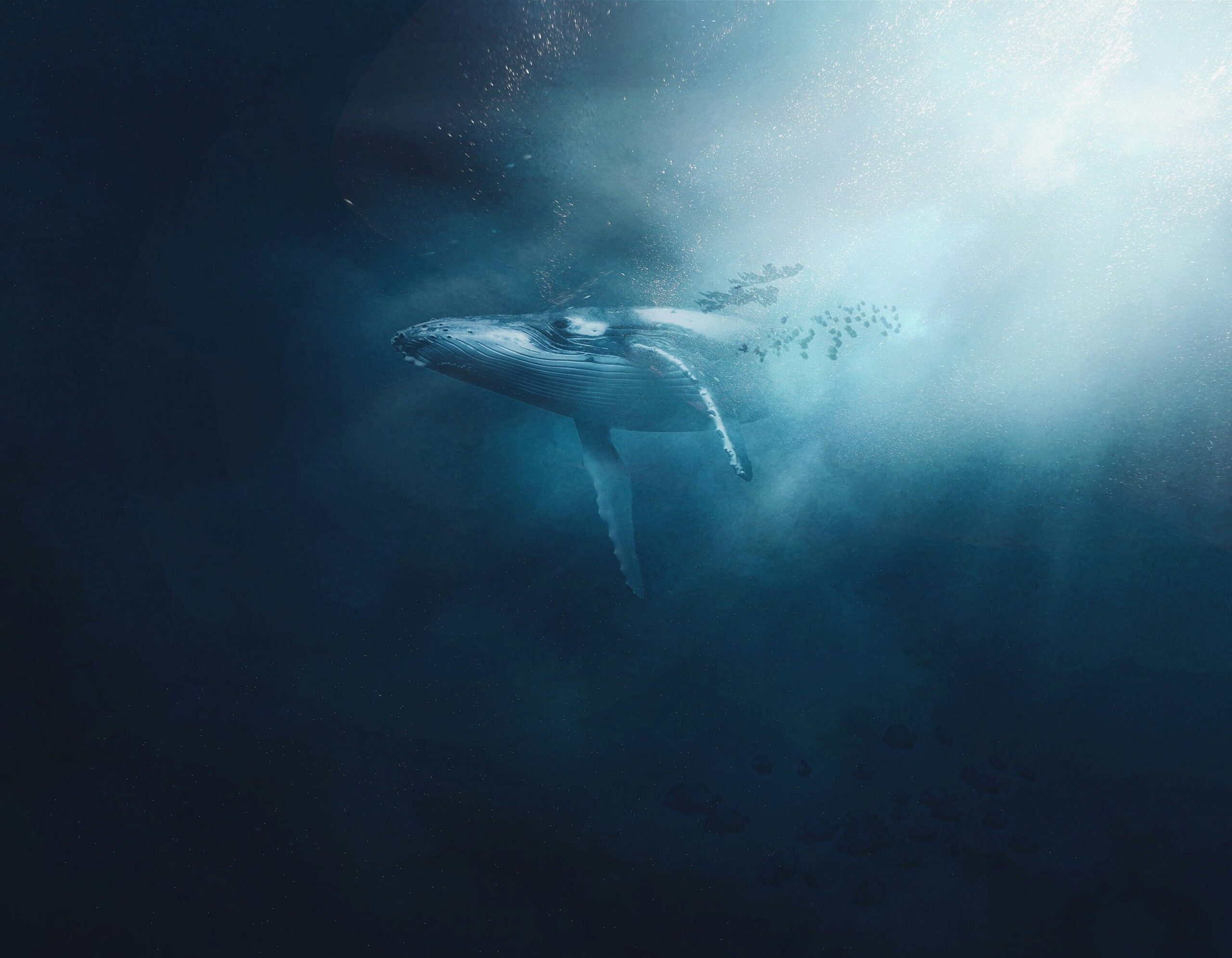
All seafaring cultures respect the sea, but fear the giant creatures that lurk within.
Sea ruin
The ships of Tarshish travelled for you in your trade. So you were filled and heavily laden in the heart of the seas. Your rowers have brought you into the high seas. The east wind has wrecked you in the heart of the seas. Your riches, your wares, your merchandise, your sailors and your pilots, your caulkers, your dealers in merchandise, and all your warriors within you, with all the company that is with you, sink into the heart of the seas on the day of your ruin.
Ezekiel 27:25–27
The ‘you’ in this passage is the city of Tyre, a Phoenician coastal port on the Mediterranean, built on an island and the neighbouring mainland. 50 miles south of Beirut in Lebanon and built apparently in 2750BC, Tyre thrived between 2000BC and AD332, when Alexander the Great destroyed it, but also built a causeway which effectively made it a peninsula. Tyre’s navigators founded prosperous trading centres elsewhere which formed a network for maritime commerce.
Ezekiel is not referring to Alexander, of course, but to the Babylonians, who under Nebuchadnezzar besieged it from 585–572BC. Ezekiel speaks of its downfall and ruin, and the reference to seafaring is not simply relevant but also metaphorical. For while Tyre’s wealth and success came from the sea, it also led to a false sense of security and arrogance in the face of potential threats. Like a ship on the sea itself, the port city was venerable and fragile. Just as ships are at the mercy of the sea, so too are the fortunes of earthly kingdoms. As well as being a reference to what actually happened, this is about the dangers of pride and materialism. For deeper security and true prosperity can only be found with God.
The imagery of the sea and ships symbolise the instability of human-made wealth and power. Ezekiel’s tirade is a poignant reminder of the transient nature of worldly power and influence and the importance of humility and faith. It also serves as a historical reminder of how apparently significant nation states rise and fall, which itself points us to the spiritual consequences of pride and materialism.
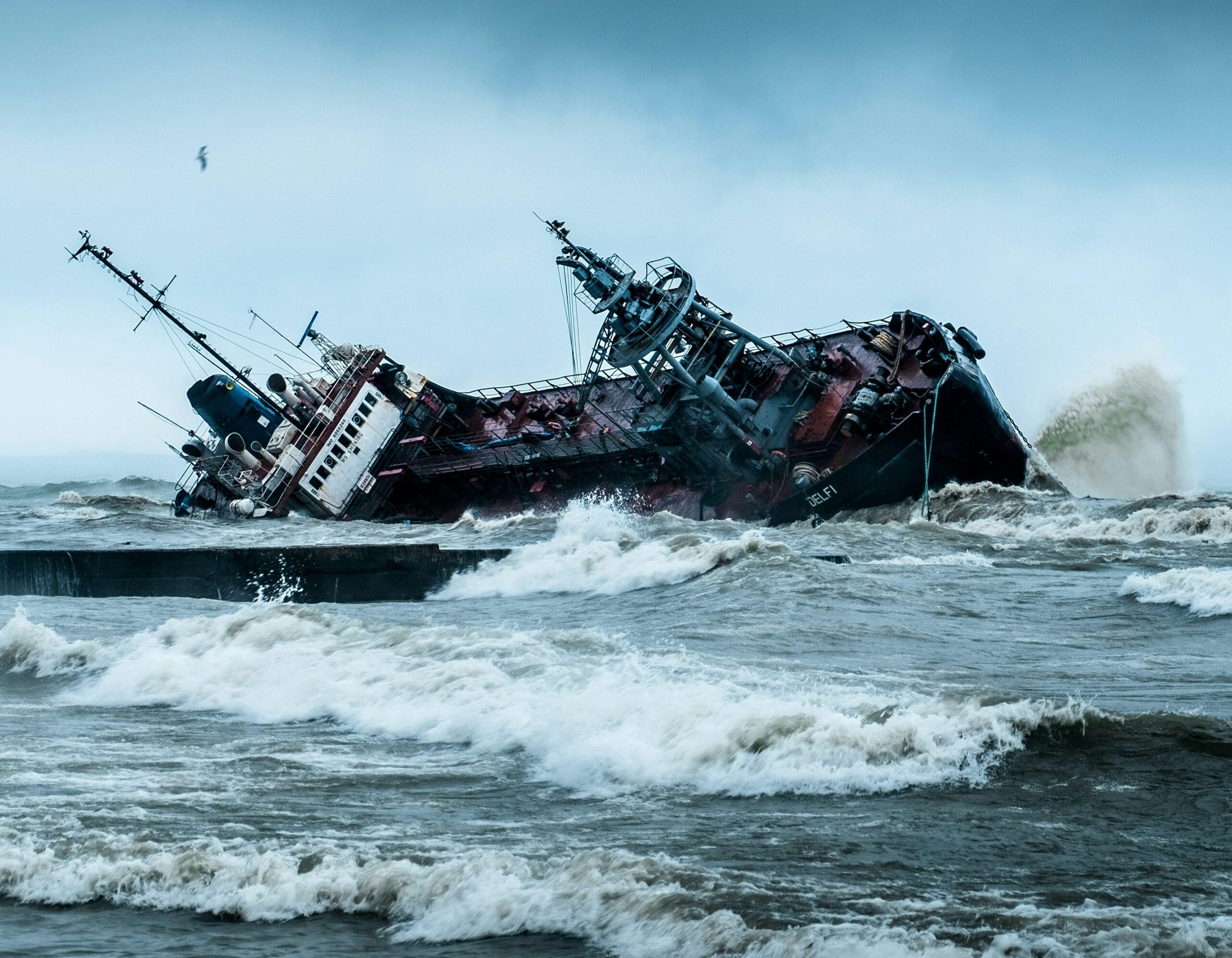
Just as ships are at the mercy of the sea, so too are the fortunes of earthly kingdoms.
Paul at sea
Embarking on a ship of Adramyttium that was about to set sail to the ports along the coast of Asia, we put to sea, accompanied by Aristarchus, a Macedonian from Thessalonica. The next day we put in at Sidon, and Julius treated Paul kindly and allowed him to go to his friends to be cared for. Putting out to sea from there, we sailed under the lee of Cyprus, because the winds were against us. After we had sailed across the sea that is off Cilicia and Pamphylia, we came to Myra in Lycia.
Acts 27:2–5
Paul, who witnessed to and preached to the peoples of Asia Minor, travelled approximately 6,800 miles by sea during his missionary journeys. This is two thirds of his total journeying of around 10,000 miles by both land and sea. Given the vast distances he sailed, it is perhaps surprising we do not hear more about them in Acts, in fact!
Acts 27 is given entirely to this journey and its unfortunate conclusion. Governed by Mediterranean currents and winds, they set sail in what may seem like the wrong direction for Rome, but it is the only way possible, via the coast, keeping to the east of Cyprus. Luke tells us that they start in Adramyttium in Greece.
Being near to Troy – a famous location in Homer’s classic Iliad – we might also think of Odysseus’ epic voyages in Greek mythology. Like Odysseus, Paul was also a seasoned sailor on tumultuous and world-changing journeys and his sea legs were steady. There were 276 people in the ship (v. 37), and the trip begins well, with the first leg ending in Myra, the town associated with the patron saint of seafarers, Nicholas, who was bishop there 300 years later.
In Ephesians 5:18, Paul writes ‘be filled with the Spirit’. At sea we might consider how sails are ‘filled’ with wind (and becalmed without it), and how the Spirit like a ‘wind from God swept over the face of the waters’ (Genesis 1:2). So the Spirit of God fills the sails of our journeying, steering, guiding, leading us over the waves, through calm and storm alike, until we reach the safe haven of our ultimate destination.