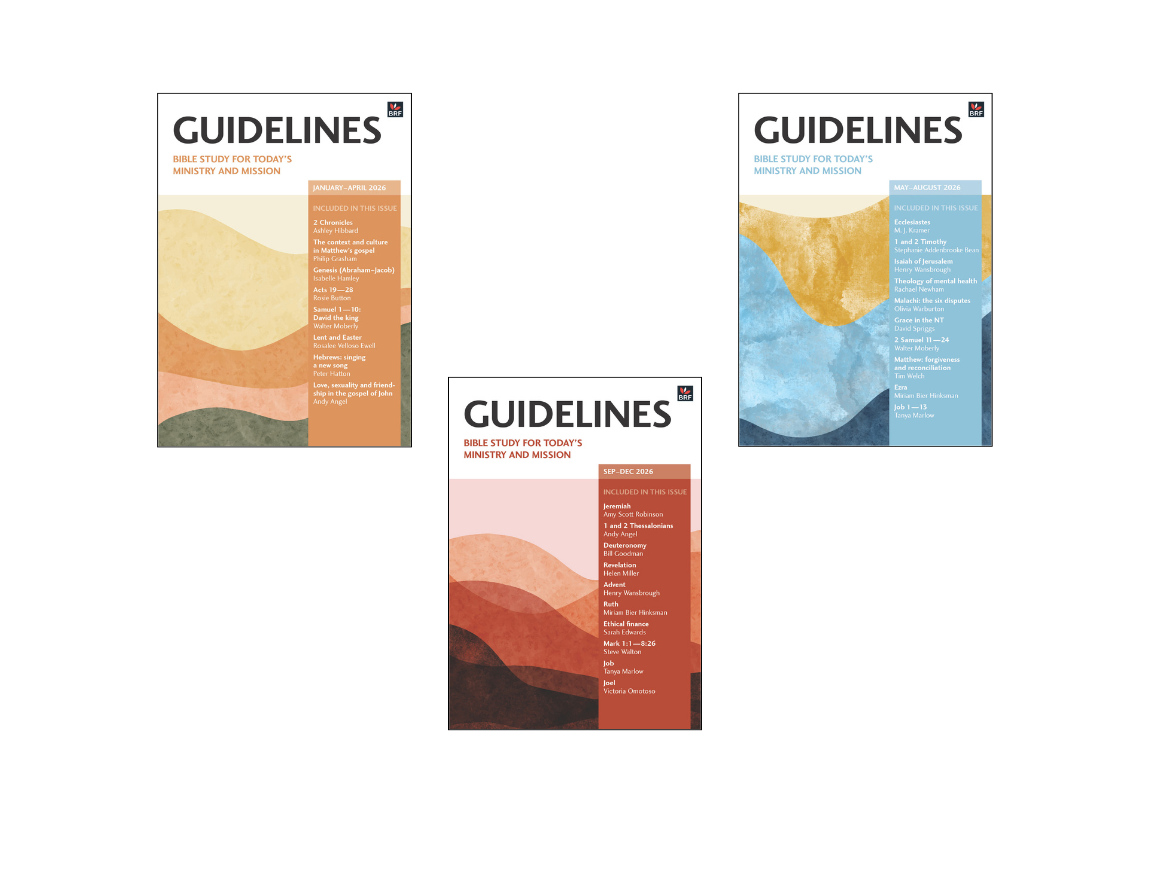

Continuing our summer series highlighting the riches of our new September–December Bible reading notes. This week, it’s the turn of Guidelines, our most in-depth study notes for those who want to delve deeper into scripture and engage with some of the latest biblical scholarship. These notes feature informed and thought-provoking reflections, ‘guidelines’ for approaching specific texts, and suggestions for further reading. In the first series of the new issue (31 August–13 September), Helen Miller focuses on the book of Revelation.
2 August 2026
About Jesus, or from Jesus?
The revelation of Jesus Christ…
Revelation 1:1 (NRSV)
It is easy to gloss over the introductory lines of a text, saving concentration until the main body of the argument begins. However, these opening words are key to understanding Revelation’s meaning.
By using ‘of’, the NRSV maintains the ambiguity present in the Greek. Does ‘the revelation of Jesus Christ’ mean that this is revelation about Jesus or from him? The NIV is probably correct to identify ‘from Jesus’ as the primary meaning. However, Revelation is also about Jesus.
While not groundbreaking, remembering that Revelation is about Jesus is essential in reading Revelation well. Those who turn Revelation into a secret code that only they can decipher or identify precise references to people and events in our own day have probably lost sight of this, approaching the text as if it were, first and foremost, about us.
As God-breathed scripture, Revelation speaks to us, as it does to people of all eras. But its primary subject is God – Father, Son, and Holy Spirit – specifically the significance of Jesus’ work in the unfolding of God’s plans for his creation.
Other topics are viewed through this lens. Earthly kingdoms rise and fall, but there is one king who reigns over all. We follow him, the Lamb, or we follow the beast. We’re citizens of the New Jerusalem or of Babylon. We’re headed towards the new creation or the lake of fire.
Such polarisations are one of the main ways that Revelation makes its rhetorical appeal. It’s not that John is ignorant of life’s complexities – the churches he writes to demonstrate the mix of good and bad that is typical of our own churches. However, shades of grey aren’t permitted to cloud his central message: this is who Jesus is; how will you respond?

Revelation speaks to us, as it does to people of all eras. But its primary subject is God – Father, Son, and Holy Spirit.
Lost love
‘To the angel of the church in Ephesus write:
‘These are the words of him who holds the seven stars in his right hand and walks among the seven golden lampstands. I know your deeds, your hard work and your perseverance. I know that you cannot tolerate wicked people, that you have tested those who claim to be apostles but are not, and have found them false. You have persevered and have endured hardships for my name, and have not grown weary.
‘Yet I hold this against you: You have forsaken the love you had at first. Consider how far you have fallen! Repent and do the things you did at first. If you do not repent, I will come to you and remove your lampstand from its place…
‘Whoever has ears, let them hear what the Spirit says to the churches. To the one who is victorious, I will give the right to eat from the tree of life, which is in the paradise of God.’
Revelation 2:1–5, 7 (NIV)
Revelation 2—3 is sometimes referred to as the letters to the seven churches. The term ‘letters’ is misleading. It suggests that all each church received were Jesus’ words to them. In fact, Revelation is a single letter that was read aloud in all seven churches. Each church heard Jesus’ words to all the churches in the context of John’s entire vision.
The messages to the seven churches are arranged in the order in which a messenger would travel. In the Lord’s providence, they also form a chiastic structure… wherein symmetry is formed through repetition.
For example, there is repetition between the first and final messages. Only these two churches (Ephesus and Laodicea) are warned that their existence is under threat if they do not repent (2:5; 3:16). The second and fifth messages also resonate with each other. Jesus has just comfort and encouragement for these besieged churches (Smyrna and Philadelphia). The three churches in the middle are compromised, but even the church in Sardis (which receives Jesus’ strongest rebuke) has ‘a few people’ who are maintaining faithfulness to Christ (3:4–5).
The church in Ephesus is commended for taking a stand against corrupt teaching and practice. They are rebuked because they have lost their first love. Commentators debate whether it is their love for Jesus or each other that has grown dim. The two are inextricably connected (e.g. 1 John 4:7–21).
Here, though, Jesus’ focus is probably on the latter. Standing firm in truthful doctrine and godly practice is vital. However, there is a danger that, in seeking to preserve our own and the church’s integrity, we adopt a self-righteous judgementalism that is devoid of the love that should lie at the heart of our Christian faith.
What does it look like to hold truth and love together? We have a perfect example in the one who welcomed people as they were but expected them to change, who bore patiently with his first disciples but told them when they erred, and who invited all to follow him but was upfront about the cost.
As we reflect on Jesus’ words to the Ephesian church, may his example inspire us to love likewise.

What does it look like to hold truth and love together?
Guidelines
When I’m teaching Revelation at Moorlands College, I encourage the students to approach Revelation as they would any other biblical book, asking, first, what did this text mean to those it was first written to and, second, what does it mean to us today?
We do this intuitively with a letter like 1 Corinthians, which clearly relates to particular situations and individuals. However, because Revelation contains prophetic imagery and apocalyptic language, we can forget that this text, too, is a letter. It’s not a conventional letter but, nevertheless, there is a specific group to whom it was first written: the churches in Ephesus, Smyrna, Pergamum, Thyatira, Sardis, Philadelphia, and Laodicea. Therefore, it’s important to understand how the Christians in these communities would have heard John’s letter before we relate its teaching to our lives today.
The diversity in these churches suggests that they may have been impacted by Revelation in different ways.
Those in Smyrna and Philadelphia, who are standing firm in their faith in the face of persecution, would have heard John’s encouragement to keep going. Although their current situation is difficult, God is unfolding his plans and purposes. Jesus’ victory is irrevocable and indestructible. Their hope of eternal life is secure.
Those in the churches that are compromising would have heard Jesus’ rebuke alongside his commendation. Revelation warns to them to repent as well as encouraging them to persevere.
Remember where we started: this is the revelation of Jesus, from him and about him. The book depicts the coming of God’s kingdom on earth as it is in heaven. We can be members of God’s kingdom because Jesus has defeated the power of sin, death, and the devil through his death and resurrection, enabling us to be forgiven and reconciled with God.
Moreover, as those who have been reconciled to God, we play a role in the unfolding of his kingdom. Revelation highlights three main ways that we do this: prayer, praise, and witness.