
Maggi Dawn explains why Lent is about far more than self-improvement.
8 February 2026
Why I am not giving up chocolate for Lent.
The real voyage of discovery consists not in seeking new landscapes but in having new eyes.
Marcel Proust
Of all the traditions associated with Lent, probably the best-known is the practice of giving something up, for the six-and-a-half weeks from Ash Wednesday to Easter Sunday. Some people give up chocolate, alcohol, or coffee, while others give up something non-edible, such as a time-consuming habit like social media. A few take the opportunity of Lent to kick a bad habit, like smoking or swearing. But why do we give things up? Where did the tradition begin, and what is it supposed to achieve?
There is clear evidence that, for at least 1,500 years, the church has kept a period of fasting during the weeks before Easter, and it’s thought the tradition may date even further back to the very early church. The word ‘Lent’ comes from the Anglo-Saxon word lencten, from which we get our word ‘lengthen’, and it referred simply to the fact that, in the northern hemisphere, the weeks leading up to Easter were the early, lengthening days of spring after the winter solstice.
The oldest traditions of Lent are interwoven with the idea of spring. Some Greek Orthodox communities celebrate the first day of Lent as the first ‘outdoor day’ of the new year, going out to greet the spring as the beginning of new life after the death that came with winter.

Why do we give things up? Where did the tradition begin, and what is it supposed to achieve?
Fasting and abstinence
In medieval Europe, fasting and abstinence were not restricted to Lent. Eating meat was prohibited by the church at least one day a week, and Fridays continued to be ‘fish day’ until late into the 20th century, as a reminder that Christ died on a Friday. There were often two or three more days of abstinence in the week, with a great deal of local variation – for instance, some areas kept Wednesday as a meat-free day to remember the treason of Judas Iscariot, and Saturday was a day to honour the Virgin Mary.
There was also a cycle of fasting through the year – the four Ember Days, which mark the beginning of the new seasons, and Advent (the four weeks before Christmas) as well as Lent. For the medieval Christian, then, meat was prohibited for somewhere between a third and a half of all the days in the year. But the Lent fast, representing the 40 days during which Jesus withdrew into the wilderness, was the toughest of the fasts.

For the medieval Christian, meat was prohibited for somewhere between a third and a half of all the days in the year.
A true fast
In theory, the Lenten fast is supposed to have several purposes: first, as a daily reminder that we depend upon God for everything; second, to draw us closer to God in prayer; and third, to reconnect us to the idea of community, as the church follows Christ’s journey through the wilderness and on to Jerusalem. But the meaning of Lenten abstinence is often blurred into a kind of self-improvement regime – giving up chocolate and desserts to lose some weight or curbing our screen-time to make life more healthy. Self-improvement is not all bad, but it does nothing to engage us with the deeper meanings of Lent.
The prophet Isaiah called the people of God to a ‘true fast’ – not a self-satisfied observance of tradition, but a fast that genuinely transformed their lives. This leads me to think that Lent demands another level of ‘giving up’ altogether: that in order to draw closer to God, and to see him more clearly, we may need to give up some of our entrenched ideas about him.
How do we identify false or blurred images of God that we have subconsciously picked up along the way? How do we allow light to be shed on those places where our idea of God is too harsh, too weak, too small, too fragile, too stern?

Self-improvement is not all bad, but it does nothing to engage us with the deeper meanings of Lent.
A true encounter
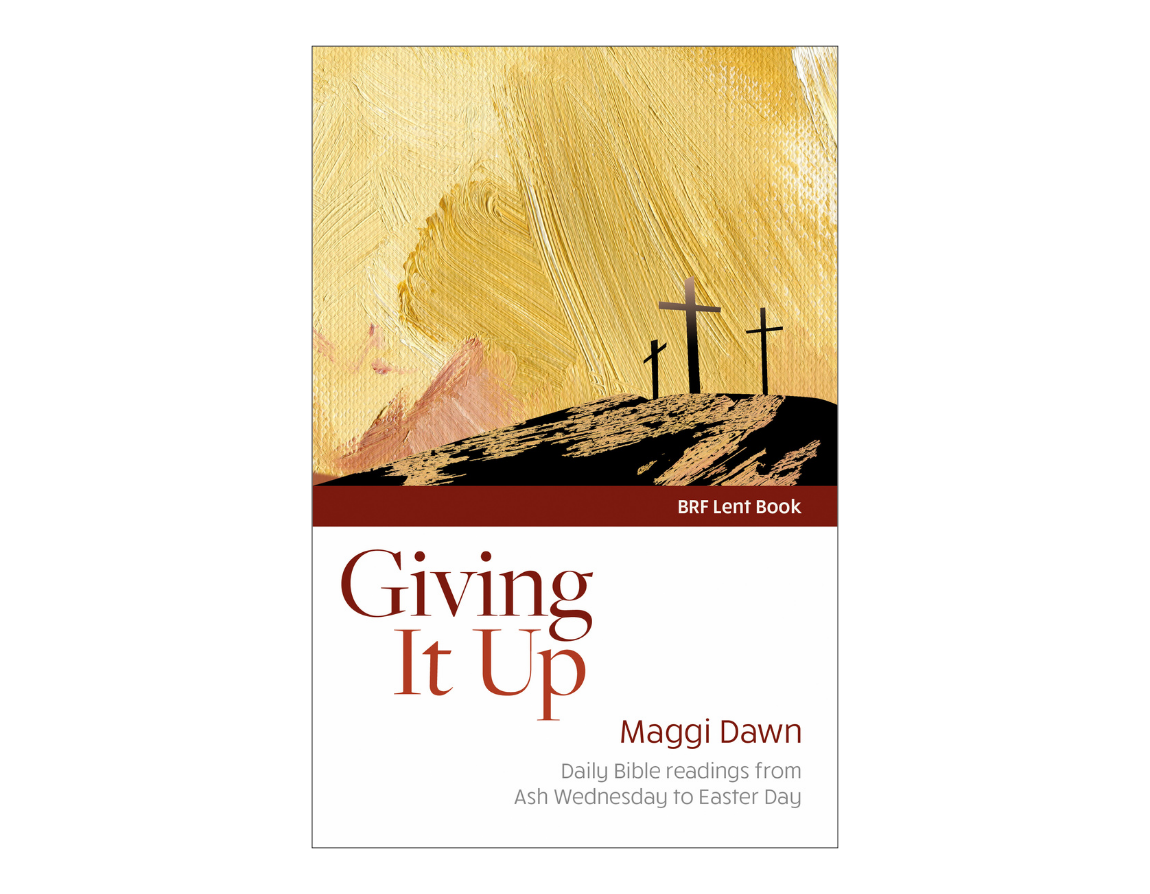
My Lent book, Giving It Up, explores Jesus’ own journey through the wilderness, and then that of various other biblical characters, many of whom had their view of God radically transformed as they traded in their old idea of God for a true encounter, and discovered how different the real God is from the god of their expectations. They were called to change their misconceptions about God, to change their minds on certain issues, and to change their lives in challenging but liberating ways. And finally, in Holy Week, to discover how different Jesus was from the Messiah people were anticipating.
Following their journeys, over and over again, has challenged my own preconceived notions of what God ‘ought’ to be like, as I have discovered a bigger, kinder, and more liberating God than I ever dared imagine.
By all means, give up chocolate, or anything else you find helpful. But you might also like to join me on my annual journey through the biblical fasts and wildernesses, to seek a clearer vision of God. As the 13th-century saint Richard of Chichester put it:
O most merciful Redeemer, Friend, and Brother,
May I know thee more clearly,
Love thee more dearly,
And follow thee more nearly,
Day by day.
This article is adapted from Giving It Up: Daily Bible readings from Ash Wednesday to Easter Day